
Concrete RV Pad Installation
Heavy-duty reinforced concrete pads for recreational vehicles, trailers, and boats across Utah County.
Why Your RV Needs a Concrete Pad
Stop Parking on Dirt & Gravel
Parking a 10,000-to-30,000-pound recreational vehicle on grass, dirt, or even gravel creates problems that compound over time. Tires sink into soft ground after rain and snowmelt. Gravel shifts and spreads, creating uneven surfaces. Mud tracks into your RV, your driveway, and your garage.
In Utah County's clay-heavy soils, a parked RV can create ruts deep enough to require professional regrading.
A concrete RV pad eliminates all of these problems. It provides a stable, load-bearing surface that keeps your RV level, clean, and accessible year-round. Concrete does not shift under static loads the way gravel does. It does not soften after a rainstorm. And it does not require the annual regrading and top-off that gravel pads need.
Property Value: A concrete RV pad is a property improvement that adds real value. If you ever sell your home, a purpose-built RV pad is a selling point for the large percentage of Utah buyers who own recreational vehicles.
Specifications
RV Pad Sizing & Specifications
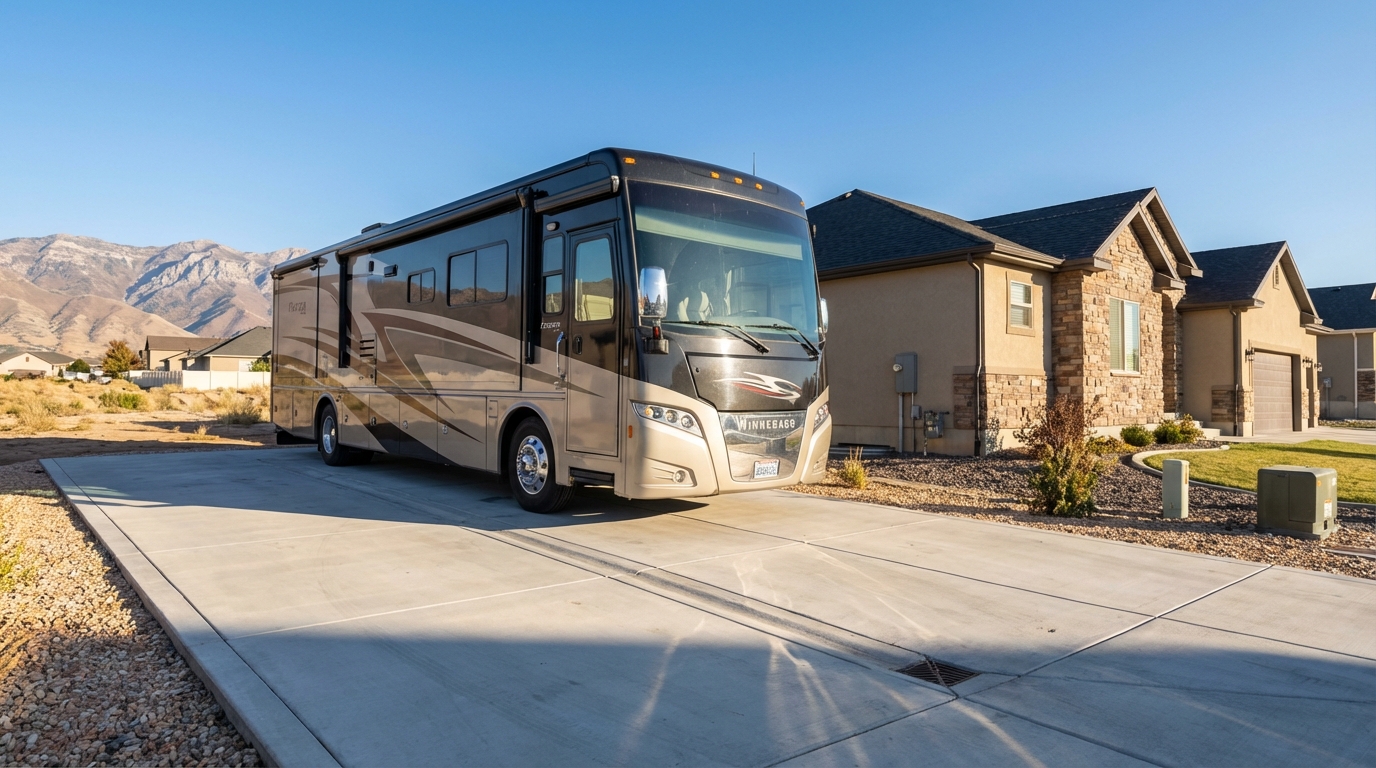
Your pad size depends on RV length, maneuvering room, and whether you want space for a second vehicle alongside.
| RV Type | Recommended Size | Square Footage |
|---|---|---|
| Travel trailer (20–30 ft) | 12 × 40 ft | 480 sq ft |
| Fifth wheel (30–40 ft) | 14 × 45 ft | 630 sq ft |
| Class A motorhome (35–45 ft) | 16 × 50 ft | 800 sq ft |
| Dual pad (RV + trailer/boat) | 20 × 50 ft | 1,000 sq ft |
Concrete Thickness by Load
An RV pad requires 5 to 6 inches of reinforced concrete, thicker than a standard 4-inch patio slab because recreational vehicles create concentrated wheel loads and long-term static pressure.
- 5″ with wire mesh:Travel trailers under 10,000 lbs GVWR
- 5″ with rebar:Fifth wheels & mid-size motorhomes (10,000–20,000 lbs)
- 6″ with rebar:Class A motorhomes & heavy fifth wheels (20,000+ lbs)
Base Preparation for Static Loads
An RV sits in one position for weeks or months at a time. This static loading concentrates pressure on the same points continuously, unlike a driveway where vehicles come and go.
- 1Excavation to the correct depth below grade
- 24–6 inches of compacted road base installed in lifts
- 3Soil assessment for Utah County’s expansive clay soils
- 4Grade adjustment to establish a 1–2% drainage slope
Drainage & Surface Finish
Standing water under an RV is a recipe for corrosion, mold, and mosquitoes. Every RV pad we pour includes a 1\u20132% drainage slope that directs rainwater and snowmelt away from where your RV parks.
For the surface, we apply a broom finish rather than a smooth trowel finish. The textured surface provides tire traction, prevents slipping in wet conditions, and reduces glare on bright Utah days.
Pricing
How Much Does an RV Pad Cost?
Concrete RV pad costs in the Utah County market depend primarily on size, thickness, and site conditions.
Included in These Prices
- Site grading & base compaction
- Formwork & reinforcement
- 5–6 inch concrete pour
- Broom finish & control joints
- Drainage slope & cleanup
Factors That Affect Cost
- Site Access:If the concrete truck cannot back directly to the pour site, a concrete pump may be needed. Tight side-yard access is common for RV pads.
- Demolition:Removing an existing gravel pad, old concrete, or other surface adds $2–$4 per square foot.
- Soil Conditions:Utah County’s clay soils vary by city and neighborhood. Some sites need additional base material or deeper compaction.
- Utilities & Obstacles:Working around existing utility lines, fences, or landscaping features can affect project scope.
- Rebar Upgrade:Moving from wire mesh to rebar reinforcement adds approximately $0.50–$1.50 per square foot but provides stronger crack resistance.
2026 RV Pad Cost Estimates
Utah County market pricing
| Pad Size | Sq Ft | Per Sq Ft | Total Range |
|---|---|---|---|
| 12 × 40 ft | 480 sq ft | $6 – $12 | $2,880 – $5,760 |
| 14 × 45 ft | 630 sq ft | $6 – $12 | $3,780 – $7,560 |
| 16 × 50 ft | 800 sq ft | $6 – $12 | $4,800 – $9,600 |
| 20 × 50 ft | 1,000 sq ft | $6 – $12 | $6,000 – $12,000 |
Get an exact quote for your specific project.
Get Free EstimateOur Process
How We Build Your RV Pad
From estimate to finished pad, here is how the project unfolds.
Free On-Site Estimate
Bryce visits your property, measures the parking area, assesses soil and access conditions, and provides a detailed written quote.
Site Preparation
We excavate to the correct depth, install and compact 4–6 inches of road base, and set proper drainage grades.
Formwork & Reinforcement
Precision forms are set to your pad dimensions. Rebar or wire mesh reinforcement is placed per the spec for your RV weight.
Concrete Pour & Finish
We pour 5–6 inches of concrete, finish with a broom texture for traction, cut control joints, and establish proper cure time.
Applications
RV Pad Applications for Utah County
Side-Yard RV Parking
The most common installation. A concrete pad along the side of your home provides a permanent parking spot that keeps your RV off the street and out of your driveway. We work within narrow side-yard spaces and can pour pads as narrow as 12 feet wide.
Trailer & Boat Storage
Many Utah County homeowners own a boat, ATV trailer, or utility trailer in addition to an RV. A wider pad (18–20 feet) or a separate adjacent pad gives you dedicated storage for multiple vehicles.
Motorhome Parking Surfaces
Class A and Class C motorhomes require the largest and thickest pads—up to 35,000 pounds fully loaded. We pour 6-inch reinforced slabs with rebar grid and can incorporate utility hookup access points.
Backyard RV Pads
A backyard RV pad keeps your recreational vehicle completely out of sight from the street. Particularly valuable in neighborhoods with HOA restrictions on visible RV parking.
Why Rhode Concrete
Why Choose Rhode Concrete for Your RV Pad
An RV pad is a simple project when it is done right and an expensive headache when it is not. The difference comes down to the crew doing the work.
Owner on Every Job
Bryce Jones and his son pour every RV pad personally. The same people who measured your yard are the same people placing rebar and finishing the surface.
No Subcontractors
Our father-and-son team handles everything. No random crew shows up on pour day. No miscommunication between estimator and installer.
Built for Utah Conditions
We understand Utah County’s clay soils, freeze-thaw cycles, and seasonal weather patterns. Every pad accounts for local conditions.
Residential Focus
Rhode Concrete works exclusively with homeowners. Your RV pad project gets full attention, proper curing time, and a clean job site.
Licensed & Insured
We hold a valid Utah contractor’s license and carry full liability insurance. Your home and property are protected throughout the project.
Our Work
RV Pad Gallery
Examples of concrete RV pads we have built for Utah County homeowners.
Common Questions
Frequently Asked Questions
Explore More
Related Services
Concrete Slabs
General-purpose slab installations for garages, workshops, and utility areas.
Learn MoreShed & Hot Tub Pads
Level concrete pads for storage sheds, hot tubs, spas, and outbuildings.
Learn MoreConcrete Driveways
New installations, full replacements, extensions, and widening for single-family homes.
Learn More
Get Started Today
Get Your Free RV Pad Estimate
Bryce Jones will visit your property, measure the parking area, assess soil and access conditions, and provide a detailed written quote at no cost and no obligation.